
In just under ten months, America will celebrate her 250th birthday. As this milestone approaches, we face an undeniable reality: our nation is deeply divided. Yet this anniversary offers us something profound, an opportunity to remember what truly makes us strong. Not our diversity of opinions alone, but our unity in foundational principles.
The Strength of Shared Principles
The divisions we see today stem from a gradual drift away from the values that once bound us together. Over decades, a “long march through the institutions” has reshaped how we understand ourselves as Americans. But our 250th birthday beckons us back to something greater, a revival of the founding values and the bold spirit captured in our Declaration of Independence. These documents were not mere political statements; they were covenants establishing both our relationship to one another and our accountability to a higher moral order.
The founders understood this deeply. John Adams, our second president, stated plainly: “Our Constitution was made only for a moral and religious people. It is wholly inadequate to the government of any other.” This was not a call for theocracy but a recognition that self-governance requires citizens who govern themselves first. People guided by conscience, virtue, and a sense of duty beyond self-interest.
A Founder’s Covenant
Consider Benjamin Franklin, one of our most influential founding intellectuals. Beyond his roles as statesman, diplomat, drafter and signer of the Declaration, and first postmaster general, Franklin was a man who wrestled with life’s deepest questions. On March 9, 1790, just weeks before his death, he wrote to his longtime friend Rev. Ezra Stiles, then president of Yale College, articulating his personal creed:
I believe in one God, Creator of the universe. That He governs it by His providence. That He ought to be worshiped. That the most acceptable service we render to Him is doing good to His other children.
That the soul of man is immortal and will be treated with justice in another life respecting its covenant in this.
These I take to be the fundamental principles of all sound religion, and I regard them in whatever sect I meet with them.
– Benjamin Franklin
Notice Franklin’s use of the word “covenant.” He chose it deliberately, and it reveals something essential about America’s founding vision.
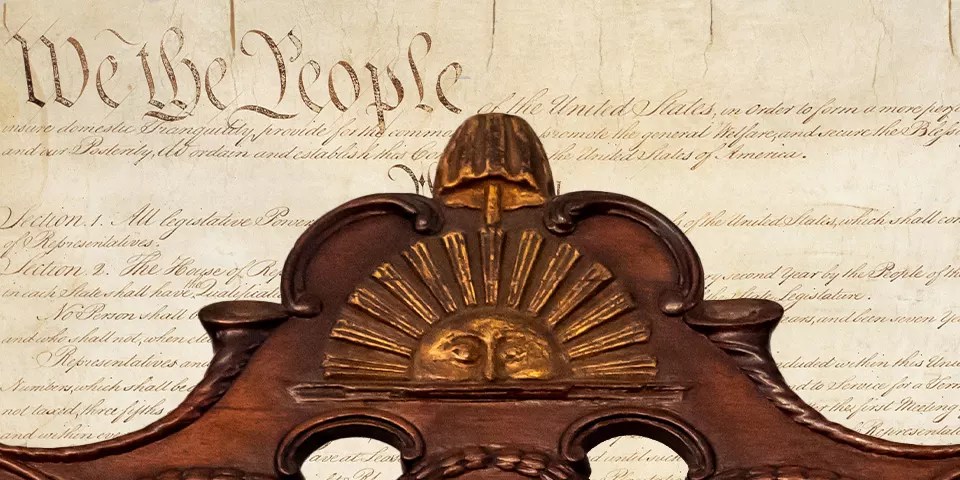
Understanding Our Founding Covenants
Our founding documents, the Declaration of Independence and the Constitution, are covenant documents. They establish sacred commitments: covenants among We the People, and covenants acknowledging our Creator as the source from which our rights flow. This is not mere religious sentiment. It’s the architectural foundation of American liberty.
The Declaration’s final sentence makes this explicit: “And for the support of this Declaration, with a firm reliance on the protection of divine Providence, we mutually pledge to each other our Lives, our Fortunes and our sacred Honor.” These men bound themselves to one another and to something transcendent. They wagered everything on this covenant.
The Constitution’s Preamble echoes this covenantal structure: “We the People of the United States, in Order to form a more perfect Union, establish Justice, insure domestic Tranquility, provide for the common defense, promote the general Welfare, and secure the Blessings of Liberty to ourselves and our Posterity, do ordain and establish this Constitution for the United States of America.”
Notice the progression: union, justice, tranquility, defense, welfare, and liberty. All secured for ourselves and our posterity. This is covenant language, promising fidelity across generations.
The Foundation of Covenant Living
If America was founded on covenantal principles, we must ask: what sustains covenant in practice? The answer lies in the institutions closest to us, our families and marriages. Marriage itself, within the biblical tradition that shaped our founders’ worldview, is fundamentally understood as a covenantal relationship. It is not merely a social contract but a sacred bond instituted by God, evident from Genesis through the New Testament.
The nature of a covenant is a reciprocal commitment. As Matthew Henry observed of God’s covenant with His people: “God covenants with them to take them into a near and very honorable relation to himself. He will be to them a God: that is, he will be all to them, and do all for them, that God can be and do. Nothing more can be said in a thousand volumes than is comprehended in these few words: ‘I will be their God.’
“They shall be to him a people, to love, honor, and obey him; complying with his cautions, conforming to his commands, copying his example. Those who have the true God for their God must and will do this, for they are bound to do so as their part of the contract. And God will enable them to do it, as an evidence that he is their God and that they are his people.”
This covenantal pattern, of commitment, faithfulness, and mutual obligation, trains us for citizenship. Strong families built on covenant teach the next generation how to honor commitments, resolve differences, sacrifice for the common good, and remain faithful even when challenged. These are not merely private virtues; they are the essential habits of a free people.
Unity Despite Differences
Here is the beautiful paradox of America’s founding vision: unity does not require uniformity. Our founding documents enable us to maintain deep unity despite honest differences of opinion. We can disagree vigorously about policy, prudence, and priorities while remaining united in our commitment to constitutional principles, civic virtue, and mutual respect.
But this unity cannot exist in a moral vacuum. It requires what Adams called “a moral and religious people,” citizens who recognize obligations beyond their own desires, who can be trusted to act with honor even when no one is watching, who understand that rights come with responsibilities.
As Hebrews 11:6 reminds us, “Anyone who comes to Him must believe that he exists.” But beyond mere belief in God’s existence, the covenant relationship means recognizing that “the God who exists is your God, filling up your life with grace suitable and sufficient.” In exchange, He offers the matchless privilege of being called His people, called to love Him, honor Him, obey Him, and to fill up your life with love and duty.
Put it all together, and the believer can declare: “I belong to Him, and He belongs to me.” This is the pattern of covenant that extends from our relationship with God, through our families, and into our civic life together.
Our Gift to America
As we approach America’s 250th birthday, we have an opportunity to give her the greatest gift possible: renewed unity. Not a forced conformity that erases differences, but a chosen unity rooted in shared principles, moral conviction, and covenantal faithfulness.
This revival begins where all lasting change begins, in our own hearts, our own families, our own communities. It begins when we recommit to the covenant our founders established: to mutual support, to sacred honor, to justice under God, to liberty secured by virtue.
America’s founding generation pledged their lives, their fortunes, and their sacred honor to establish this covenant. Our generation’s task is to renew it, to restore unity through faith, strengthen families through fidelity, and rebuild our country on the firm foundation of the values that made us great.
The question before us is simple: Will we answer the call? Will we rebuild America to reflect her founding promise? Will we demonstrate that unity, true unity, built on shared principles and mutual honor, is indeed America’s greatest strength?
Our 250th birthday awaits. Let us make it a true celebration of renewal, a rededication to the covenant that binds us together, and a testament to the enduring power of unity in a free and faithful people.
A Martyr’s Legacy – Faith, Family, & Country
On September 10, 2025, Charlie Kirk gave his life for the cause of faith, family, and country. Assassinated while speaking to students at Utah Valley University, he was martyred for standing firm in his convictions and calling Americans back to their founding principles. His death was a tragic loss, but it need not be in vain.
May the good that comes from Charlie Kirk’s sacrifice be the revival that leads to unity of the American people, unity in our faith, our families, and our country. Let his martyrdom awaken in us a renewed commitment to the covenant our founders established. Let it inspire us to stand courageously for truth, to rebuild what has been broken, and to ensure that America, on her 250th birthday, reclaims the unity that has always been her greatest strength.
Charlie Kirk stood for something worth dying for. Now we must prove it is worth living for.
“A republic, if you can keep it.”
– Benjamin Franklin’s response to Elizabeth Willing Powel’s question at the conclusion of the Constitutional Convention on September 17, 1787: “Well, Doctor, what have we got, a republic or a monarchy?”
 MindWolves